Saturday, April 3, 2010

Interest rates and Bonds

Long term rates have been slowly creeping up and bonds have been pulling back. We believe that an intermediate trend reversal is close at hand. Bonds are expected to mount a rally that could last a couple of months after which they are expected to resume their downward trends. Long term traders can use this potential surge in bonds too slowly ease into additional TBT positions; risk takers can purchase long term call options in TBT.

In the short to intermediate time frames, bonds could rally as high as 120 and possibly spike to the 122 ranges. Feb 2, 2010.

We still have daily and weekly sell signals, in effect. The first sign of a trend change would be a daily buy signal and the ability of bonds to trade past 118 for 4 days in a row. If bonds can trade above 118 for 4 days in a row, it will signal that they are ready to test the 122-124 ranges. If we get a weekly buy signal it would result in much higher prices and bonds could trade as high as 128 before pulling back. Even though the current pattern is suggesting that bonds could rally for several months in a row, this pattern will only be complete if it is confirmed with a weekly buy signal.

Right now we would advise long term players not to open up any new short positions via TBT and to actually consider taking some profits with the intention of redeploying this money later when bonds trade to the above suggested targets.

We will warn everyone via updates or interim updates when a new daily and weekly buy signal is generated.

Long term our outlook for the bond market is extremely negative but in the short to intermediate time frames bonds are expected to rally. The strength of the rally will depend on the signals generated (daily, weekly, etc.)


The Ultimate stock Timing System

VIP Futures System; win ratio of over 85%

Thursday, April 1, 2010

Slavery and the mass mindset


Slavery in the true sense never disappeared, it has just changed. The chains have been replaced with cubicles and the only difference is that you now hold the keys to your own prison and you gladly, and willing incarcerate yourself.

The masters controlled the land in the old days and the people that worked the land, today they control skyscrapers and the people that work in them. What has changed? They have just sugar coated the deal. They provided individuals with the illusion that they were free, i.e. no longer tied to the masters who owned the land. Notice how many individuals gladly and proudly speak of working for a company for 20 plus years. The average person starts to work (we won’t count odd jobs that one might do while one is a teenager or while one is attending college) roughly at say 21-23 years of age, and they work until roughly 65 years. Thus roughly the average person works for 42 years, in this time the average vacation is roughly 1 ½ month, so in 42 years you get 63 months of vacation, which works out to roughly 5.25 years of time to do sit down and relax. Is this really freedom? One has just given the most valuable years of one’s life to have enough so that one can live a so called comfortable life in the worst years of one’s life. They called retirement the golden age, but it should be called the Bronze Age, for one has just given up gold in exchange for bronze. So is there any solution; yes there is, all one has to do is look for one.

In order to break free from the physical and mental prison one needs to see one’s predicament and only in seeing can one formulate a plan. It’s for this reason why most will never break free, why the mass mindset will always dominate, and why the same old tricks and scams work again and again. Ask yourself this question. Do you really think the top individuals are that stupid? Why is it, they never seem to learn from history, why is it that governments for some strange reason keep making the same mistake again and again? The truth is that they are not stupid; in a nefarious manner of speaking, they are in fact brilliant. They know that the masses forget, they learn nothing and that through the use of greed and fear they can achieve anything. It’s for this reason we will always have booms and super busts. Every cycle is engineered in advance.

This is a very long and deep topic, so we are only just scratching the surface but to bring about change all it takes is a desire to want the change. Thus if this topic has stirred enough interest, it has served its purpose for finding a solution is the easy part.

As for what one can do personally. As we stated before, if one can identify the problem one is more than half way at finding a solution. If you see the game for what it is then you are no longer a slave for you can formulate a way to break free. That is why one should never retire; retirement should be viewed as getting away from what you had to do, to now doing what you love to do. A retired mind is a dead mind.

Mass Psychology 101


It’s an old phenomenon but one that has only been brought to light recently. It is something that is encoded in all beings, we tend to feel comfortable doing things together. One can even see this in other animals, a flock of birds a herd of beasts, a shoal of fish, etc they all seem to follow a leader.

Mass Psychology is the study of group behaviour; the mass mindset draws comfort from the fact that everything is okay because the majority support this view point. In other words, an investor feels comfortable enough to buy technology stocks because it appears that everyone thinks that high tech is the way to go.

The way to profit from this phenomenon is to do something that is contrary to our upbringing and most of our cultures and that is to resist the herd mentality and try to be a leader. In any crowd, or group behaviour situation, the ones that lead are the ones that draw all the benefits, while the ones that follow blindly are the ones that take all the risks. This is very clearly illustrated in the stock market. Let's take the internet era of the 1990’s.

Investor who took the time to analyse what was going on, could see that the internet would revolutionize the way information was transmitted; the consumer would finally move from the passenger seat to the drivers' seat. They also noted with great interest that the public at that time was against or completely ignoring this sector; this is a key facet of mass psychology. They took positions in these stocks as early as 1994 to early 1995, with the majority taking stakes in 1996, the masses only began to awaken to this phenomenon in mid to late 1998, by 1999, there was a feeding frenzy as everyone simply piled in.

The leaders were alarmed at this behaviour, as they should have been, since this frenzy was not sustainable. Knowing that the end was near, they started to sell towards the end of 1999 and move their assets into cash and bonds, while the feeding frenzy continued. In March 2000 the markets started to correct and by the end of the year the main up trend line was violated and the market was ready to crash. By 2002 the market had lost more than 70% of its value and many of the masses who had momentarily tasted wealth were reduced to a state of poverty that they could not have envisioned a few months back.

1) The leaders represent less than 2% of the population yet take in more than 90% of the profits. Getting to this stage is not easy as it involves changing ones ingrained modes of.

2) You have to learn that whenever something is popular the end is very near.

3) That the time to take a position or start something new is when it is viewed with extreme negativity and disdain.

4) You have to learn how to fight the fear of selling out to fast after taking a position, remember it won’t just go up., most likely it could even go down a bit more or move sideways for months or even a year. The one area you can draw comfort from is this, the longer the sideways action the more powerful the upward move will be when it finally transpires.

5) Keep extra money to take additional positions.

6) In all likelihood you will have a 50-100% retrenchment in the first stage of the bull market, meaning that your shares could double only to fall back to the original value you purchased them at. This is usually known as the shakeout stage, whereby the weak hands are forced out of their positions and end up selling at rock bottom prices. Hold and the rewards are extremely huge.

7) When the investment suddenly becomes topopular be on guard and perform simple trend analysis on all your holdings, once the super main up trend. Wait patiently for the next opportunity to show up, there is always another opportunity.

This is meant to be a brief introduction into the very esoteric but highly rewarding field of Mass psychology, to do an in depth analysis would take months. When one combines Mass psychology with Technical analysis you truly have a very potent weapon that can be used very effectively to position oneself in the right investments and consistently be on the right side of the market.

The term contrarian investing was most likely derived from the study of mass psychology as it basically means taking a position that is completely at odds with the masses.

With that in mind, mass psychology has once more provided a new opportunity in the financial markets for the astute individual willing to take an early position and wait. Sectors that are going to explode even further in the years to come are the precious metal's sector, the energy sector, agriculture, etc.; virtually anything tied to commodities will do well in the years to come.

It would be wise to have a position in several of the key stocks in each sub sector of the commodity's markets. A starting point would be to establish a position in Gold and Silver bullion.


www.thewinningzone.net

Monday, March 29, 2010

The Fannie May and Freddie Mac debacle

No man is happy without a delusion of some kind. Delusions are as necessary to our happiness as realities.
Christian Nevell Bovee, 1820-1904, American Author, Lawyer

Meanwhile, taxpayers have pumped more than $125 billion into the failed firms -- and on the hook for many more after the administration promised an unlimited source of funds just before Christmas to backstop their growing losses. "We will do everything necessary to ensure these institutions have the capital they need to meet their commitments," Geithner said in response to tough questions from Rep. Scott Garrett, a New Jersey Republican. Underscoring the need for change, Geithner acknowledged that taxpayers are likely to face "very substantial" losses on the government's takeover of Fannie and Freddie.

Republicans on the panel want to dismantle Fannie and Freddie within five years, arguing that the government-backed firms cost taxpayers too much with little to show for it -- hundreds of billions in taxpayer losses for a housing finance system rife with moral hazard issues and a crowding out of private companies from the market. Full Story

When Geithner states that they will do everything to make sure these institutions have the capital they need to function, he is basically stating that they are willing to use tax payer’s money to fund two worthless entities, instead of dismantling them. Trying to keep these agencies floating is akin to pouring money into a bottomless pit.

One of the old lines was that these two agencies helped make housing affordable by providing an avenue for individuals who would not normally qualify for a mortgage. The following quote was extracted their site.

Fannie Mae works to increase the supply of affordable for-sale and for-rent housing across America by creating customized financing solutions with our housing partners. These financing solutions help ensure stable, livable neighborhoods. Through multiple community development investment funds, Fannie Mae works to tear down barriers, lower costs and increase opportunities for homeownership and affordable rental housing for all Americans. Full Story

They have been a failure in every sense of the word; in trying to provide affordable housing they indirectly provided banks with the incentive to sell as many mortgages as possible. As soon as the deal was closed the banks could get these mortgages of their books by dumping them onto these two agencies.

Some background info on these two companies

They were created by the Federal National Mortgage Association in the 1930’s to help speed up the home ownership process by buying mortgagees from banks. Banks would normally sell a mortgage and then put it on their books, this means that each time they did so, a certain amount of capital was tied up and this limited the number of mortgages they could issue. Now they could simply issue a mortgage and sell it to Freddie or Fannie and as a result banks could issue almost as many mortgages as they could sell.

Although they are private companies, they are government sponsored enterprises established by federal law. As GSE’s they received special privileges, the main one being that if they were threatened with failure, the federal government would come to their rescue. This gave them the best of both worlds; profits are privatised but losses are socialized. This guarantee basically encourages immoral and unconscionable behaviour because there is no downside; the downside becomes the government’s problem, which in turn becomes the tax payer’s problem.

Now let’s examine if they really helped the public

Freddie Mac lost 50 billion last year but has now come begging to the government for another 31.8 billion and this comes on top of the 13.8 billion Freddie asked for last year. The government has pledged a massive 200 billion line of credit to support this disaster and based on all the talk so far, they would probably offer even more if Freddie ever needed it.

If we weigh the cost to the taxpayer and the so called savings these two mortgage giants provided, one finds that they failed miserably and have really provided no benefit at all. How can this be? The so called benefits from offering lower mortgage rates has been offset by the cost of all the money taxpayers have poured into these two companies. . They had access to money at a lower rate than private companies and could in turn pass these savings to the consumer; lenders provided them with lower rates because their survival was guaranteed by the Federal government. Based on the amount of money they have already asked for and the future amounts they will need to continue functioning, it is estimated that by the end of the year they will become net losers. In other words, they would have moved from providing some value to providing none at all.

Lawrence J. White an economist at the New York University (Stern School of business) states that the GSE’s could borrow money 35-40 basis points lower than the private sector. Thus if the standard rate was 6%, they paid only 5.60-5.65%.

At the end of 2008 these two companies had 31 million mortgages on their books, which were worth in excess of 5 trillion (actual figures were roughly in the 5.4-5.6 trillion ranges). Thus borrowers would have saved roughly 10 billion in 2008. According to Daniel Gross over the years, they supposedly produced savings of $100 billion.

If we compare this potential $100 billion in savings they have provided against the $300 billion plus in financial support the Government has pledged to both these agencies, the conclusion is clear; these two companies have provided no benefit at all. In fact, one has to wonder why they continue to exist as they have now become a monumental liability. It is true they have not used up all the money the government has pledged to them (at least not yet) but at the rate, they are burning this money, it’s only a matter of time before they go through those funds before they start begging for more. Thus would it not be better to dismantle these two monstrosities and cut and end the haemorrhaging.

If one were to state that these guys had a large role to play in the financial crisis that hit this nation, one would not be too far off the mark. After all they did provide banks with an incentive by virtually buying any crap that the banks were willing to throw at them.

The government is hell bent on pouring good money into completely useless projects, but when it comes to helping individuals; they find ways to make painful cuts. Point and case, not approving a $250 checks for senior citizens. To make matters worse they create money out of thin air to pay for these black hole projects, thereby further devaluing our currency and indirectly imposing a silent tax on the population. The only way investors can protect themselves under such conditions are to make sure that one puts a portion of one’s money into hard assets; the simplest way to do this would be to purchase some Gold, Silver or Palladium bullion.

The people of the world having once been deceived, suspect deceit in truth itself.
Hitopadesa, 600?-1100? AD, Sanskrit Fable From Panchatantra


The best free stock market tools


Top futures timing service, 5 year win ratio over 75%

Thursday, March 25, 2010

The Competitive currency devaluation era gains momentum

You can fool all the people all the time if the advertising budget is big enough.
Ed Rollins

Portugal has just had its credit rating cut and both Greece and Spain are now begging the EU to set up a bailout fund to help the beggar nations (PIIGS) who are unwilling to curb their spending habits. In our previous article, we made the following comments.

Indirectly they have been begging for assistance from the very start. This aid package will trigger other beggar members of the PIIGS group to eventually join the handout club. Next in line is probably Spain. If the top members of the EU wanted to send a strong message to the weak members they should have stuck hard and fast to their previous claims that no aid would be forthcoming. Euro Woes, Part II: Have We Entered the Devalue or Die Era?

Now that Portugal has its credit rating lowered, Spain has started making noise about setting up a bailout fund. Not too long ago they stated that all was well, and that they should not be compared with Greece. Ironical is it not that they have now joined up with Greece in demanding a fund be set up to help nations that are having problems financing their debt.

French and Germany appear to have reached some agreement (the key word being appear) as indicated by the story below

The safety net - not yet agreed by the whole eurozone - would total about 22bn euros (£20bn). It would apply only if market lending to Greece dried up. Eurozone countries would grant co-ordinated bilateral loans, and there would be "substantial" IMF loans. The "majority" funding would be European. EU leaders are poised to discuss the plan at a two-day summit in Brussels. Full Story

We could go on about the potential ramifications of the above idea but there is something that is more interesting that we would like to speak off.

Germany and France knew that they would eventually come to the table and approve some sort of package even though they made a lot of noise about doing nothing in the beginning. No one has bothered to ask why. The reason is by playing this cat and mouse game, they have allowed the Euro to lose a significant portion of its value; in effect, they indirectly devalued their currency without actually officially having to do so. Each time they put out a story to calm the markets they leave room to change their position. The story above and the just released story below are perfect examples of such ploys in action. While France and Germany have agreed to set up a fund, they leave extra wiggle room by stating that this matter would still need approval from the whole euro zone.

The market's advance fizzled after European Central Bank's president Jean-Claude Trichet told French television that Europe must take responsibility for its financial problems. That raised concerns about when a rescue for Greece might come. Officials from European nations were meeting late Thursday to discuss their economic problems.

Investors have been concerned for months that problems in Greece and other debt-strapped countries in Europe would spread and spoil a global economic rebound.

"Any time we see comments about it it seems to spook the market," said Adam Gould, senior portfolio manager at Direxion Funds in New York, referring to Greece's financial problems. He said traders still expect Greece will get a bailout but the questions about how unnerved investors. "It's more the uncertainty." Full story=

A single nation can easily devalue its currency but in the Euro zone a single nation does not have this power. The large members can, however, pretend like they are not willing to help the smaller weaker members and thereby create a mini confidence crisis; the net result the Euro loses some of its value.

The US is deflating its currency by printing money at a stupendous rate, China is devaluing its currency by pegging it to the weak Dollar and countries like Vietnam simply openly devalue their currency in order to maintain a competitive edge. Expect this trend to pick up steam; it’s now going to be a race to the bottom of the pit, and it will only end with a full blow currency crisis. Investors should make sure they have a position in precious metals. Don’t think of it as investment, think of it as insurance just in case the house burns down. Use strong pull backs to add to your positions.

He who doesn't have legs cannot teach one how to walk
unknown

If you are interested in a trading service with a high win ratio (currency futures, commodity plays, etc) than consider giving our service a try. Our 5 average win ratio is in excess of 75% and our 12 month win ratio has jumped to 84%. The Winning Zone.

Tuesday, March 23, 2010

A small but Strategic victory for Google

After issuing many threats that it would pull out of China Google was left with little wiggle room, and it looked like they had backed themselves into a tight corner. It was a given that the Chinese government would not cave into their demands. Doing so would have made them look weak not only among their people but also to the rest of the world. Thus Google’s latest move to redirect traffic to Google hung Kong is a very smart move for in one shot it exposed just how much content the Chinese government insists on censoring.   Instead of getting an error message or simply producing no search results, users are greeted with a message that states Page is unavailable. This move now shifts the burden of censoring content from Google shoulders to that of the Chinese Government via its “great firewall” and at the same time is a small victory for Google as it has the Chinese government on defence now as indicated by the following statement.

Google has "violated its written promise" and is "totally wrong" by stopping censoring its Chinese language searching

results and blaming China for alleged hacker attacks, a government official said early Tuesday morning.Full Story

Google’s current strategy to redirect its China site to its Hong Kong site Google has virtually given up nothing and achieved all the following benefits in one shot.

Made the Chinese Government look foolish and directly exposed the level of their censorship. This together with Google’s “evil meter” (this metre shows what the Chinese government is blocking in real time) has now enabled the whole world to see the extent of china’s censorship.

It has not lost any of its Chinese Traffic, and it managed to catch the Chinese government off guard with its sudden announcements as evidenced the host of silly responses from government officials.

It has stopped censoring search results, transferring this burden to the Chinese government instead.

And finally it has the option to redirect traffic back to China. Cn if a new agreement with the Chinese government can be reached.

In conclusion, Google’s victory while small is somewhat significant. It has been able to stick to its guns without giving up its stake in the world’s fastest growing internet market. 


www.dailyreckoning.net

www.thewinningzone.net

Monday, March 22, 2010

Palladium; the Stealth bull Market.

The steeper the mountain the harder the climb the better the view from the finishing line
Anonymous

Palladium was the underdog of the precious metals sector for a long time, because for the most part it hardly received any attention. In the last few months this all changed and with the introduction of the Palladium ETF (PALL), Palladium has finally emerged from the shadows to the spotlight. Now the average Joe has a way to jump in and out of Palladium without having to actually purchase the metal. In reality owing the physical is far better than buying the ETF, but that is a topic for another day. When the Gold ETF was introduced it helped drive the price of gold bullion because it provided an easy means to jump in and out of Gold and so investors piled into it; from nowhere in a few years GLD has grown into a juggernaut. GLD is now the 6th largest holder of gold bullion in the world. In the same manner demand for Palladium is going to rocket upwards with the introduction of the Palladium ETF (PALL). PALL hit the markets on the 8th of January and it has already had an impact on Palladium’s price. Note that Palladium is the only precious metal that has actually put in a new 52 week highs in the face of a stronger dollar

While demand dropped a bit in 2009 due to the economic crisis, this drop did not seem to prevent this metal from surging to a series of new 52 week highs. In fact, in the past 15 months, palladium is the best performing precious metal.

China’s appetite for Palladium is growing at a voracious rate. A report by David Jollie published in May 2009 by Johnson Matthey states that demand in Chian surged from 500,000 oz to 650,000 ounces, in 2008. Demand from the Jewellery sector was rather strong in the first three quarters of the year.

In 2008 there was a surplus of 460,000 ounces but net demand still climbed by 15,000 oz, to 6.85 million oz, although the world as a whole was going through one of the worst economic crises in the last 60 years.

The palladium market was in surplus by 460,000 oz in 2008 and yet net palladium demand climbed by 15,000 oz, to 6.85-million ounces, despite the economic slowdown.

Production, on the other hand continues to fall mainly owing to lower production by the two major players in this sector, Russian and South Africa. Production fell to 7.31 million ounces in 2008, a fall of almost 15%. Investment demand for Palladium climbed to 400,000 ounces in 2008, a rise of over 50%. ETF’s were the major players purchasing 370,000 ounces and demand via coins and small bars jumped to 30,000 ounces.

As of Feb 2010, the Palladium ETF PALL has 430,000 ounces of Palladium. This is a huge amount of Palladium; to put this in perspective consider the fact that it took the London ETF over 2 years to accumulate the same amount.

As stated below the demand for precious metals (Palladium, Platinum, Gold and Silver) is increasing at a voracious pace and the story below quite clearly illustrates this point.

Investments in precious metals such as gold, silver, platinum and palladium are in feverish pitch across China. No wonder, then, that the Chinese consumption of precious metals is dramatically going up, and up. China consumed 395.6 tonnes of gold in 2008 for jewelry and investment, reports the World Gold Council, or around 14% of global demand, up from 327.8 tonnes in 2007. In 2009, gold jewelry and investment demand in China is expected to reach 432 tonnes, compared with 422 tonnes from India.

On the derivative exchanges, China's Gold Futures trading volume hit 1.49 trillion Yuan in 2008. This is likely to double in 2009. Ditto platinum and palladium. Physical Chinese demand for platinum jewelry was at around 0.76 million ounces last year, accounting for 68% of the global total of 1.12 million ounces. The latest forecast sees that hitting 1.5 million oz in 2009, which even if it is a gross rather than net (of recycling) remains impressive. The Chinese jewelry demand for palladium increased from 15.5 tonnes to 20.2 tonnes, making palladium another hot commodity in China. Full Story

China usurped India as the World’s largest consumer of Gold this year and will probably end up being the largest consumer of all the remaining 3 precious metals in the years to come.

Now let’s take a look at the Technical picture.
clip_image002

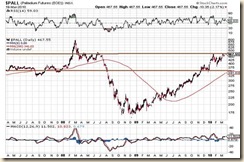
Palladium took a massive beating in 2008 and surrendered all its prior gains in a matter of months. However, this proved to be a buying opportunity of a lifetime, and we continuously pounded the table from late to 2008 to early 2009 and even went so far as to inform our subscribers’ that it had fallen into the screaming buy category. The term screaming buy is rarely used, and we only use it when we feel that we have spotted an investment that is extremely undervalued with incredible upside potential. From low to high Palladium surged well over 120% in a period of roughly 15 months; an incredible rate of return to say the least.

It broke through the 1st resistance point at 375 with relative ease and is now attempting to break past an even stronger zone of resistance. The $465-$475 ranges make up a zone of very strong resistance, and most likely it will take several attempts before palladium manages to break past this zone; once it does though it should be clear sailing to the 550-600 ranges.

clip_image003

Palladium is now at a very important junction; it has just broken through the long term down trend line and is attempting to break out of a 10 year channel formation. Palladium will now need to trade past the 465-475 ranges for 12 days in a row. If it can achieve this, it will set up the base for a rally that could take it all the way to the 800-890 ranges. If we had to put a time frame on this, we would say that once it trades past the 456-475 ranges for the suggested period of time, it could hit these targets within 12-18 months.

The real bull market, however, will only begin when palladium trades past 1100. Taking an even long term view; a close above 1100 on a monthly basis and the ability to trade past this level for 15 consecutive days in a row, should lead to a test of the 1500-1700 ranges.

Conclusion

On our proprietary timing indicators Palladium has an open Buy signal on the daily, weekly and monthly time lines, so the long term outlook for this metal is rather bright. It is the only precious metal that went on to put in a new 52 week high in the face of a stronger dollar. More importantly it is also the only precious metal that did not issue a weekly sell signal at all during the dollar’s surge upwards; it momentarily issued a daily sell which has long since been neutralized.

The long term and the very long term outlook for Palladium is extremely bright. In the short to intermediate terms Palladium is due for some profit taking as it has mounted a tremendous rally in the past 15 months. Prudent investors would be wise to use any strong pull backs to add to or open up new positions in this metal. Investors will one day look back and view the current price as a bargain, do not make the mistake of looking out the window and wishing you had bought it. Now that you have the chance make sure you at least have a small position in it and use pullbacks to add to this position. While purchasing PALL might be one way to take a stake in Palladium, our preferred method of choice is Palladium bullion. Our bullion dealer of choice is Larry Labrode, our subscribers have dealt with him for years and his service and knowledge are simply outstanding to say the least. You can make contact with him at www.silvertrading.net

One who has imagination without learning has wings without feet.
Joseph Joubert, 1754-1824, French Moralist